
Designing Safer Waste Storage Bays to Reduce Fire Risk
In our latest blog about the operational risk that fire can create within waste management and recycling facilities, Owen Batham, Core Precast Director, discusses how designing safer waste storage bays can reduce the hazard.
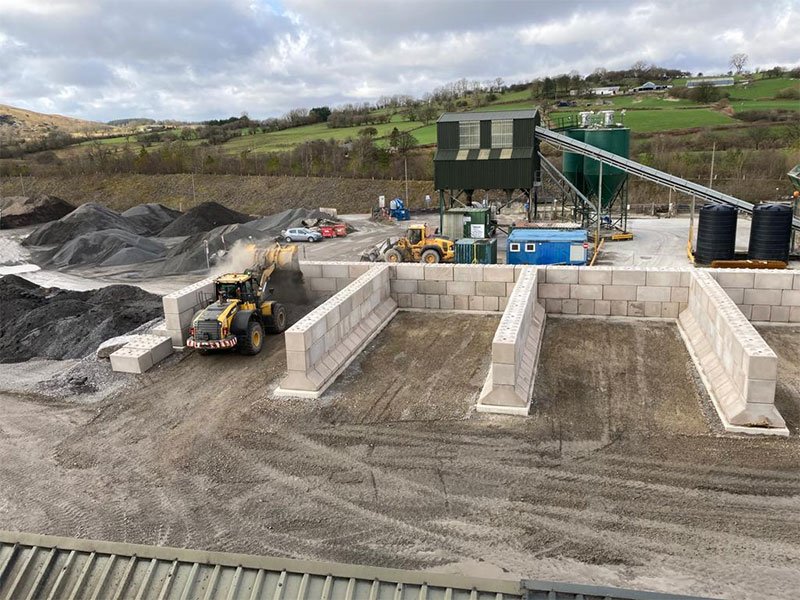
Combustible materials can often be stored in large volumes, with different waste streams can presenting very different fire behaviours and once a fire becomes established it can spread quickly between storage piles. Effective site design therefore plays an important role in both preventing fires from spreading and giving emergency services the access they need to respond safely.
Well-designed waste storage bays can help operators create clearer segregation, control pile sizes, introduce physical fire breaks and organise vehicle movements across the site, says Owen.
For these applications, modular precast concrete systems such as Legato® provide a robust and adaptable way to create clearly defined waste storage areas.
Why Waste Storage Bay Design Matters
Good waste storage is about more than maximising the amount of material that can be held on a site. The layout should support everyday operations while also considering what happens if a fire starts.
The Environment Agency's fire prevention guidance for permitted sites storing combustible waste requires operators to consider matters including pile dimensions, separation distances, fire walls, firefighting access and the location of different storage areas.
This means fire risk needs to be considered as part of the physical layout of a facility rather than treated purely as an emergency-response issue.
Segregate Different Waste Streams
One of the first principles of safer waste storage is segregation. Different waste streams can have significantly different fire characteristics. Wood, plastics, paper, textiles, rubber, WEEE and refuse-derived fuels, for example, should not simply be regarded as one generic category of combustible material.
Clearly defined storage bays make it easier to separate materials according to:
Waste type
Particle or fraction size
Combustibility
Processing stage
Fire risk
Operational requirements
The Environment Agency also expects operators to identify the specific wastes being stored rather than relying on broad descriptions and to show where different storage areas are located within the site's fire prevention plan.
Physical segregation can make day-to-day stock management clearer while helping prevent an incident involving one waste stream from immediately affecting another.
Control Maximum Pile Sizes
Bigger isn't necessarily better when it comes to combustible waste storage. Large, continuous piles can make fires more difficult to access, isolate and extinguish.
Smaller, controlled piles can reduce the potential scale of an incident and make it easier for operators and firefighters to reach affected material.
Environment Agency guidance therefore sets maximum pile sizes for various combustible waste streams and particle sizes. For waste piles covered by the guidance, the general maximum height is 4 metres, while the maximum length or width is 20 metres. Maximum permitted volumes then vary according to the waste type and its physical form. For example, the guidance distinguishes between materials such as wood, plastics, paper and cardboard, textiles, rubber, WEEE and RDF/SRF.
Rather than designing storage areas around the largest possible heap, operators should establish clearly defined maximum capacities for individual bays and manage stock levels accordingly.
The precise bay and pile dimensions should always be determined by the site's permit, fire prevention plan, waste characteristics and relevant risk assessment.
Create Effective Fire Breaks
Separation is one of the most effective ways of limiting fire spread.
The Environment Agency identifies two principal approaches: providing sufficient separation distances between combustible waste piles or using appropriately designed fire walls and storage bays.
Where open separation is used, the guidance generally requires at least 6 metres between combustible waste piles, as well as separation between waste and buildings, site boundaries and other combustible or flammable materials. Site-specific requirements can vary depending on the materials and risks involved.
However, dedicating large areas solely to separation distances is not always practical, particularly on busy or space-constrained sites.
Concrete bay walls can provide a physical division between waste streams while helping create fire breaks within the storage area.
Appropriately designed fire walls can also allow facilities to organise their available space more efficiently while maintaining the separation required by the site's fire strategy.
Why Concrete Is Well Suited to Waste Storage Bays
Concrete is particularly suited to this environment because it combines physical durability with inherent fire-resistant characteristics.
Waste storage walls may be exposed to:
Heavy plant and loading equipment
Impact and abrasion
Outdoor weather conditions
Repeated loading and unloading
High volumes of stored material
Potential fire exposure
Precast concrete provides a robust, low-maintenance solution capable of dealing with these demanding operational conditions.
Unlike combustible construction materials, concrete does not add fuel to a fire. Its high thermal mass can also help provide separation between adjacent areas during an incident.
For waste facilities, the result is a walling material that can fulfil both an everyday operational function and form part of a wider fire-risk-management strategy.
Maintain Clear Access Roads
A safe waste-storage layout must also work for vehicles.
Sites need sufficient room for collection vehicles, loading shovels, material handlers and other operational traffic to move without compromising storage boundaries or emergency routes. Access roads should therefore be considered at the earliest stage of bay design.
A planned layout can help:
Separate storage and vehicle movements Clearly positioned bay walls define where waste should and should not be stored.
Prevent encroachment onto access routes Physical boundaries discourage stockpiles from gradually extending into traffic routes.
Maintain turning and manoeuvring space Bay positioning can be coordinated around the operational requirements of HGVs and site plant.
Create clearer site circulation Defined storage areas make the overall site layout easier for both staff and visitors to understand.
Concrete systems are also widely used to create and protect operational zones and manage vehicle movements on industrial sites.
Protect Emergency Vehicle Access
If a fire does occur, emergency access becomes critical.
Fire appliances need to be able to reach the affected area without being obstructed by stored waste, parked machinery or poorly positioned piles.
The Environment Agency specifically requires fire prevention plans to identify main fire-engine access routes, alternative access routes and access points around the site perimeter that can assist firefighting operations.
Waste bay layouts should therefore be designed so that firefighting access is maintained even when the site is operating close to its planned storage capacity.
Important considerations can include:
Clear emergency routes
Adequate turning areas
Access to more than one part of the storage compound
Unobstructed routes to water supplies
Access to individual waste bays
Space to isolate or move material during an incident
A storage system should help reinforce these routes rather than rely solely on painted lines or operational procedures.
Designing Fire Walls and Storage Bays
Fire walls can form an important part of a site's strategy for preventing fire from moving between waste piles.
Environment Agency guidance states that fire walls and bays should resist both flaming and radiative heat and provide an appropriate period of fire resistance. For sites operating under this guidance, fire walls are expected to achieve at least 120 minutes' fire resistance, with their design and dimensions justified within the fire prevention plan.
Where waste is stored within bays, the guidance also requires operators to maintain a minimum 1 metre freeboard at the top and sides of the walls, helping prevent fire spreading around or over the barrier.
The correct specification remains project specific. Wall height, length, construction and layout should therefore be developed as part of the overall fire strategy and engineering design rather than treating the wall as a standalone product.
Creating Waste Storage Bays with Legato® Interlocking Blocks
Elite Precast Concrete's Legato® interlocking blocks provide a flexible way to construct substantial modular waste storage bays.
Legato® blocks are manufactured from high-strength precast concrete and can be used to create equipment storage bays, compounds and temporary or permanent site divisions.
For waste and recycling operations, the interlocking format enables individual walls to be positioned to create:
Separate waste bays
Dividing walls between different waste streams
Perimeter storage walls
Fire-break structures
Quarantine or isolation areas
Operational compounds
Because the blocks arrive ready for installation, substantial storage structures can be created without relying on conventional masonry construction.
Elite's interlocking systems are designed for rapid installation and can be installed without specialist fixing methods, helping reduce construction time and disruption on operational sites.
Legato® Storage Bay Layouts
One of the major benefits of modular walling is the freedom it gives operators when designing the site. A simple linear arrangement can create a series of side-by-side bays for individual waste streams.
For example:
Bay 1 — Wood
Bay 2 — Cardboard
Bay 3 — Plastics
Bay 4 — Mixed recyclable material
Concrete dividing walls provide clear physical separation between each area, while an open frontage allows loading equipment to enter and material to be handled efficiently.
Layouts can also incorporate wider fire breaks, quarantine areas and dedicated circulation routes according to the site's specific fire prevention plan.
The important point is that the walling system can be configured around the operation rather than forcing the operation around a fixed building.
An Expandable Modular System
Waste sites change.
We understand that contracts change, waste volumes fluctuate and new material streams can be introduced. A storage facility designed around today's requirements may need an entirely different configuration several years later.
This is where modular precast walling offers a significant advantage.
Rather than constructing every bay as a permanently fixed structure, modular systems can make it possible to expand or reconfigure the layout as operational requirements evolve.
Elite's precast systems are already used where rapid reconfiguration; temporary or semi-permanent installations and phased site development are required.
With Legato®, additional blocks can be used to:
Extend existing bays
Add new waste streams
Divide oversized storage areas
Alter bay dimensions
Create additional fire separation
Establish new quarantine areas
Adapt traffic and access arrangements
This allows investment in storage infrastructure to support the site's longer-term development rather than only its immediate requirements.
Structural Safety of Legato® Storage Bays
Structural safety is a critical consideration when designing storage bays for waste and recycling facilities, where walls may be subjected to significant lateral pressures from stored materials as well as impacts from loading shovels and other heavy plant.
Elite Precast Concrete’s Legato® interlocking concrete blocks provide a robust, high-strength modular walling solution that can be engineered to suit the specific material, bay height and operational requirements of each facility. Their substantial mass and interlocking profile create stable, durable walls capable of withstanding the demanding conditions associated with waste, recyclables, aggregates and bulk materials.
However, storage bay walls should never be designed on block weight alone; factors include:
Material density
Surcharge loads
Wall height
Ground conditions
Anticipated vehicle interaction
Correctly specified and installed, Legato® storage bays provide a strong, dependable and adaptable solution that helps operators create safer, clearly defined storage areas while maintaining the flexibility to reconfigure facilities as operational requirements change.
If in doubt, always seek advice from a qualified structural engineer.
Safer Storage Through Better Site Design
Reducing fire risk at waste and recycling facilities requires a combination of good management, appropriate procedures and carefully considered infrastructure.
The physical storage layout can support all three.
A well-designed facility should make it easier to segregate waste streams, control pile sizes, maintain fire breaks and preserve access for emergency vehicles.
Modular concrete storage bays can then turn those principles into clearly defined physical areas.
With high-strength precast concrete and a flexible interlocking design, Legato® allows operators to create robust waste storage bays that can be installed quickly, expanded as capacity increases and reconfigured as site requirements change.
For waste transfer stations, recycling facilities and industrial storage operations, this combination of fire separation, operational durability and modular flexibility can help create safer and better-organised sites.