Legato® Interlocking Blocks for Railway Embankment Protection
Railway Embankment Protection - Elite Precast Concrete
Railway embankments can face demanding conditions, from persistent rainfall and water erosion to steep slopes and restricted access. Protecting these assets requires an engineered solution that addresses the cause of instability and can be constructed within the practical constraints of the site.
What are Legato® Interlocking Blocks?
Elite Precast Concrete’s Legato® interlocking blocks provide a modular precast option for rail embankment protection schemes. Incorporated into a project-specific design, they can form retaining structures, stepped revetments and erosion protection works that help safeguard railway infrastructure.
Supporting Railway Embankments
Erosion at the toe of an embankment can remove support from the slope above, contributing to ground movement and affecting the railway. Where watercourses run close to the line, effective protection may require a combination of drainage improvements, flow management and structural support.
Why Choose Elite Precast
With decades of precast expertise, in-house engineering support and a proven delivery record on projects of every scale, Elite Precast is the partner specifiers trust. We pair robust, repeatable manufacturing with the flexibility to engineer bespoke solutions when a standard product will not do.
Key Applications
Legato® blocks can be specified as part of an engineered solution for:
Embankment toe protection: Structures designed to protect vulnerable areas against erosion.
Retaining walls: Supporting retained ground where the system is suitable for the site conditions and loading.
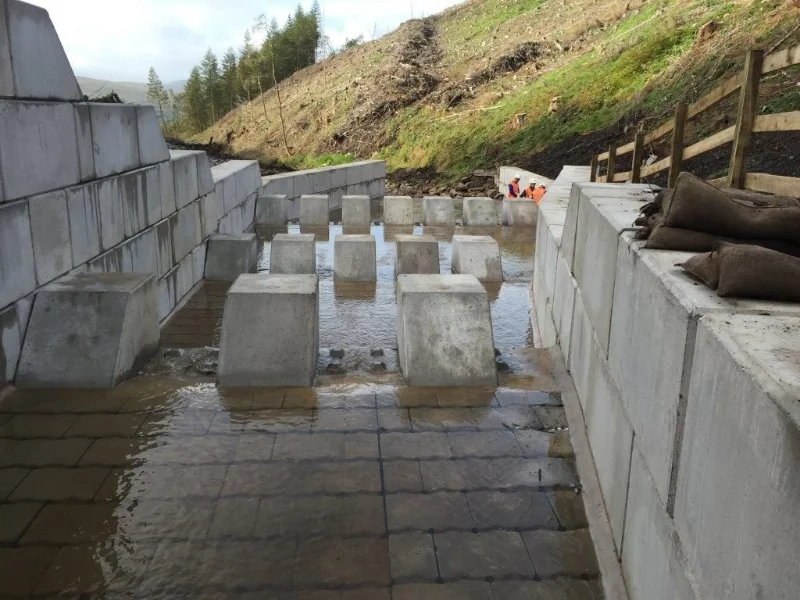
Stepped revetments: Forming protective structures alongside watercourses.
Weirs and associated protection work: Incorporating precast blocks into structures designed to manage water flow.
Embankment reconstruction: Providing a structural component within wider stabilisation schemes.
Each application requires assessment by the project’s designer, including the effects of groundwater, scour, ground conditions and railway loading.
Benefits
Engineered for Your Environment
A Practical Solution for Challenging Rail Sites
Remote locations and restricted access can make railway civil engineering works difficult to deliver. Extensive on-site concrete casting may require additional equipment, labour and careful management of weather and curing conditions.
Legato® blocks are manufactured off site and delivered ready for placement. Their interlocking geometry allows individual units to be assembled into the designed arrangement, helping simplify construction and reduce the amount of concrete casting required on site.
Concrete foundations or other supporting works may still be required, depending on the design.
Why Choose Legato® Interlocking Blocks for This Application?
Designed Around Your Project
Successful embankment protection depends on understanding the site and selecting a system that meets its requirements.
The design should consider ground bearing capacity, foundation requirements, wall stability, retained material, drainage, scour and loads associated with the railway and nearby activities. Access, lifting equipment and the construction sequence should also be assessed early.
Elite Precast Concrete can discuss product options and supply requirements with contractors, consultants and rail infrastructure teams to support the development of a suitable solution.
Project Example: Risehill Tunnel
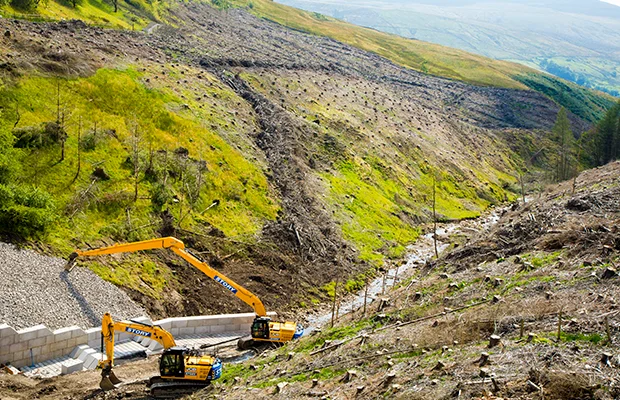
Near Risehill Tunnel on the Settle & Carlisle railway, erosion from Cowgill Beck was affecting the embankment toe and contributing to slope instability.
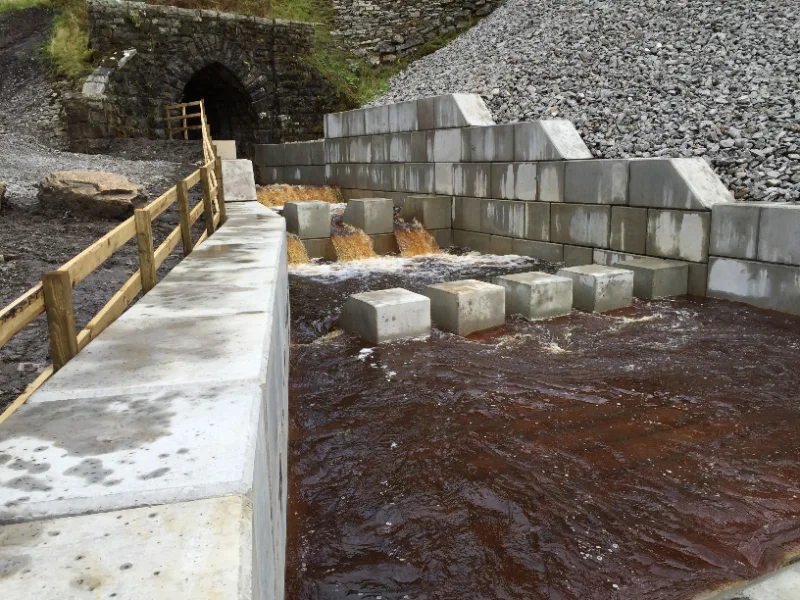
Working alongside Story Contracting, AECOM designed a stepped revetment, weir and retaining structure using 245 Legato® interlocking blocks supplied by Elite Precast Concrete.
The remote site was accessed via a 1.4-mile haul road across challenging terrain.
Factory-manufactured blocks provided a practical way to construct the complex arrangement, with units mechanically positioned on concrete foundations.
The project demonstrates how modular precast construction can support an engineered drainage and embankment protection scheme in a demanding rail environment.